In 2001, Oberst’s Law boldly predicted the growth rate of Web. During the first decade of the Web’s existence, the number of pages doubled every six months, mirroring the principles of Moore’s Law. As the Web matured, the law anticipated this rapid growth would decelerate, shifting to a pace of doubling every year, and eventually every two years. Fast forward to 2016, when Google last measured the Web’s vast landscape, revealing an astonishing 130 trillion pages. True to Oberst’s projection, over those 15 years, this figure had doubled yearly. Given the explosive usage of the Web by hundreds of millions of individuals globally, combined with the dynamic nature of “pages” generated by social media, enterprise systems like AWS and Oracle, e-commerce giants such as Amazon, AI advancements, and streaming services, the Web continues its remarkable ascent, expanding at an exponential rate reminiscent of the ever-expanding Universe itself. The table below compares 2020 Web Vision’s predictions to what has transpired.
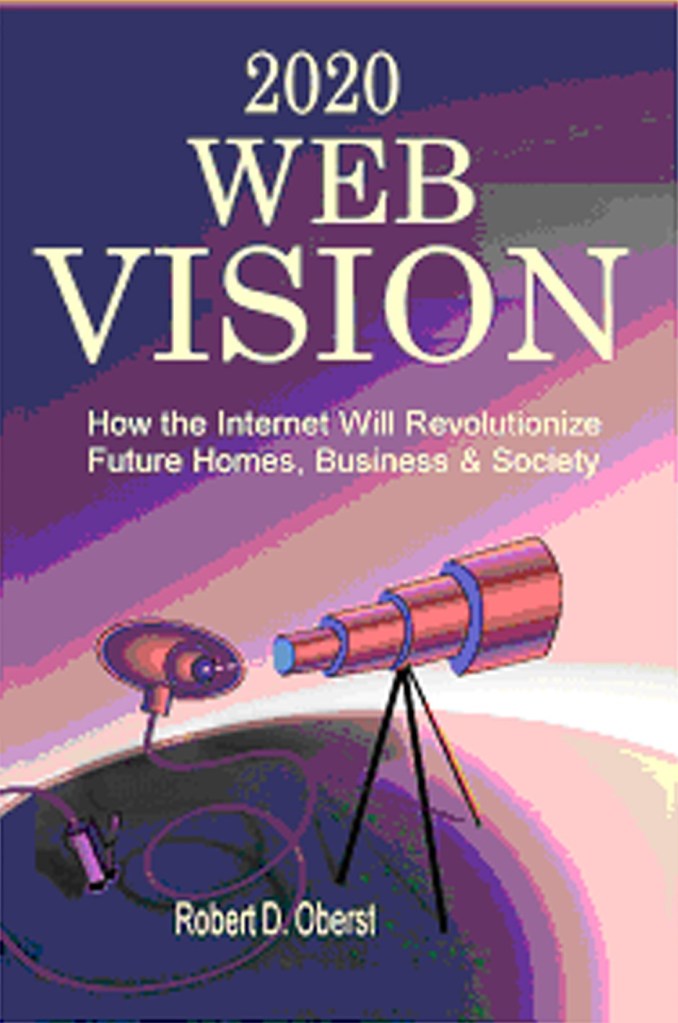
“2020 WEB VISION” appeared in over a dozen countries on five continents, in universities such as Harvard, and at think tanks such as Pew. Over three-quarters of the predictions from this visionary work have come to life, revolutionizing our world with on-line shopping, transforming movies and education, and home offices. We’ve witnessed new migration patterns emerge, the globalization of work, and the haunting demise of traditional malls, all while entering the first phase of the Cloud. The future holds even greater promise, with innovations like virtual sales representatives, virtual office clubs, earth-saving circular delivery centers and the dynamic second phase of the Cloud on the horizon.
As we stepped into a new millennium, faith in technology reached exhilarating heights. Ambitious dotcoms, often lacking experience and tangible assets beyond a daring idea, soared to astounding market valuations in the billions. However, reality crashed in as countless dotcoms perished. The once high-flying NASDAQ plummeted over 60%, and what began as the longest economic expansion in U.S. history spiraled into a devastating recession that shook our very foundations.
Despite the disconcerting scenario, it was not the demise of the Web, but merely the conclusion of its innocent childhood or the first stage of meteoric growth. After all, the Web was only 10 years old. There were still trillions of dollars worth of opportunities, as the more rigorous applications waited to be accomplished. The Web is a revolutionary event (perhaps a once in 500-year transformation), yet there was no evident vision of its future. This book projects the Web into 2020s and beyond and will be of interest to anyone intrigued by it. The book clarifies the murky Web, showing how it will interconnect emerging digital technologies to revolutionize our home, work, and society.
PREDICTIONS VERSUS REALITY
| PREDICTION | RESULT | EXAMPLES |
| HOMES | ||
| Movie streaming | Happened | Netflix, Prime |
| Music streaming | Happened | Spotify |
| Speech recognition | Happened | Alexa, Siri |
| Speech translation | Happened | |
| Online education | Happened | Numerous colleges |
| 3D shopping online | Happened | Ikea, Amazon AR View, Ohio Lodges |
| 3D travel | Happened | Google Earth, virtual reality |
| Financial systems online | Happened | Nearly all banks |
| Virtual tutors | Happened | Khan Academy, Coursera |
| Virtual concierge | Happened | Velocity Black |
| Virtual doctor house calls | Happened | Numerous healthcare systems |
| Virtual changing rooms | Happened | Warby Parker, Macy’s, Nordstrom |
| Elderly Robot Assistant (ERA) | Close | Japan, TIAGo, MIT |
| Brain computer interface somewhat | Partially | Neuralink evolving |
| BUSINESS | ||
| Online meetings | Happened | Zoom, Microsoft Teams |
| Outsourcing company operations | Happened | AWS, Oracle |
| Globalization of work | Happened | Most large companies, many small |
| Automation of service sector | Happened | Virtual CSRs, Online chat |
| Manufacturing 10% by 2020 | Partially | 8.5% |
| New migration patterns | Happened | Idaho, Florida |
| Knowledge based companies | Happened | Meta, Alphabet, Chat GBT |
| Seniors working after retirement | Happened | AARP |
| Government online | Happened | Social Security, Medicare, States |
| Political Leverage | Happened | Facebook in 2016 campaign |
| Virtual human-like sales reps | Partially | Sales Ambassador, Avataris |
| Virtual Office clubs | Happened | StartMart, COhatch, |
| Robotic arm Pickers (RAPERS) | Close | |
| Web boxes | Not Yet | |
| Full Web delivery centers | Not Yet | |
| Second stage of the cloud | Not Yet | |
| SOCIETY | ||
| Social media | Missed | |
| Virtual online communities | Happened | PatientsLikeMe, Reddit, Coursera forums |
| Repurposing of malls | Happened | College campus, Corporate offices |
| Religion online | Happened | Joel Osteen, Talk to Jesus |
| Low Earth orbit satellites | Happened | Starlink |


REVIEWS 4.8 out of 5 Stars *****
***** Shirley Elliott A good read… I was about as Web savvy as a tube of toothpaste. Had I purchased this book then I would have understood little to none of the content… I am amazed Mr. Oberst had such a complete grasp of how the Web would change our lives in the next two decades. Though this is not a long book it has a plethora of information so reading it quickly is not an option. The information is well covered and explained. I’d recommend this book to anyone who is interested in how far back the Web has affected our personal lives, businesses, and most all other facets of what it takes to run our society and how it will affect us all in the future.
***** Jerry Palmisano, A technician’s view. For the last four years I have been concentrating on the technical aspects of Web development. This book provided me with the background and business perpective I was missing so I can relate the work I’ve done to the larger framework of e-business. I would highly recommend this book.
****Hy Sockel, D.B.A. A weekend read Web Vision is not primarily a book about the Internet, the Web, e-business, or e-commerce; it is a vision of how these technologies will take society forward. The Internet is more than thirty years old and its technology is poised to enable society to take off in new directions. The book, Web Vision, explores these directions in logical and insightful ways… The book is well thought out, well reasoned, and well presented; consequently it is easy to read and follow. The ideas presented are done in a straightforward non-technical non-threatening manner… I found the chapters addressing work and virtual society to be particularly interesting. The author explores how cyber space can be used to create virtual offices, virtual meeting places, and virtual commuting, thereby providing a driving force in the next generation of work and play. The idea that technology can be used to help society’s problems is well presented and appealing.
**** “Web Vision is an excellent tool for evaluating the possibilities of not only the Web and its future, but of its impact upon our lives.”
 Global Future Press